

Ship of Fools
How the Spirit of Tasmania became the greatest infrastructure disaster in the state’s history

First published in The Monthly, February 2026
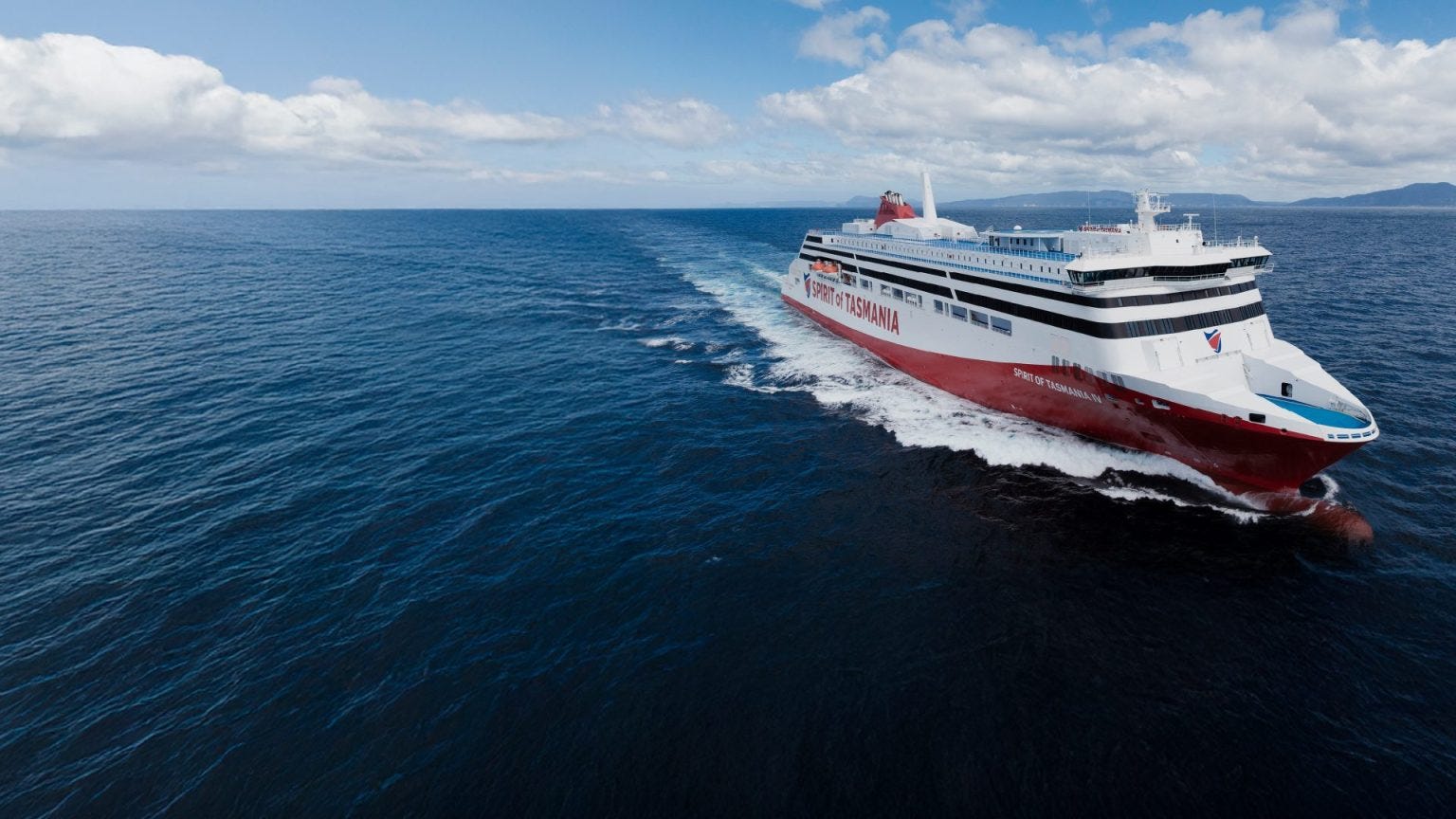
The Spirit of Tasmania is more than a daily passenger service linking the island state to the mainland. It is a lifeline for Tasmanians, an umbilical cord across Bass Strait transporting tourists and goods that keep the state functioning. But Tasmania’s dependence on the mainland is far deeper than what can be shipped aboard its ferries. Two thirds of state government revenue also comes from across the water, making Tasmania more reliant on Commonwealth support than any other state. Even so, Tasmania is barely managing. Its public sector finances have been deteriorating for the past decade and its debt levels are sky-high and rising. It struggles to provide basic services such as health and education. Its political system is in perpetual upheaval, while somehow never changing.
There’s something symbolic about the state’s catastrophic fumbling of the Spirit of Tasmania project. Faced with an opportunity to improve links and welcome more visitors from the mainland, the state’s leaders, whose straightforward task was to deliver two new ships to replace the two old ones, have made every mistake it would appear possible to make. But this rolling failure, almost comedic in its ineptitude, is an unconscious cry for help from a deeply troubled state.
As the government prepares to embark on an even more expensive and complex project, the new stadium at Hobart’s Macquarie Point, the distress flares of the Spirit of Tasmania are burning brightly.
In 2017, when the Tasmanian government first announced the two new Spirit of Tasmania ships, the project was miraculously already “two years ahead of schedule”. Ahead of which particular schedule wasn’t clear, but the bottom line from the then premier, Will Hodgman, was that the next-generation vessels would be delivered by 2021. It was a heady prospect both for the Liberal government and the people of Tasmania. Even more impressive was that Hodgman could announce this achievement before his government had even signed the construction contracts.
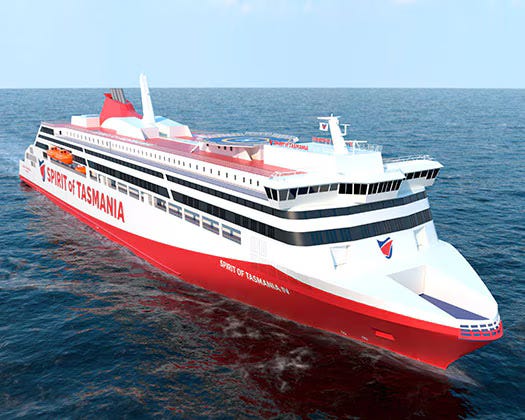
The new Spirits, IV and V, would be based in Devonport, and would be 30 per cent larger than the existing Spirits (I and II), increasing passenger and freight capacity by around 40 per cent. The 212-metre-long new vessels would each accommodate 1800 passengers. TT-Line, the state-owned company that operates Spirit of Tasmania, “had carefully assessed vessel types and fleet configurations over the past several years to determine the most appropriate vessel to operate daily crossings on Bass Strait”, according to then chair Mike Grainger. The financial disaster of Spirit of Tasmania III, which travelled unprofitably to Sydney and back from 2003 to 2006 before being sold off, was no doubt still fresh in local minds.
The tourism industry was enthusiastic about the new plan, and already counting the days. Businesses began investing to accommodate the incoming hordes.
TT-Line was expected to sign the contracts for the new build in the first half of 2018, according to then infrastructure minister Rene Hidding. As it happened, the former bankrupt used-car salesman and police minister would not be the one to oversee the contract signings: he stepped down from his ministerial responsibilities for a failed bid at the parliamentary speakership, and soon afterwards resigned from parliament altogether following allegations of historical sexual abuse against a minor. (Hidding denied the allegations.)
TT-Line announced in May 2018 that it had contracted German shipbuilder Flensburger Schiffbau-Gesellschaft (FSG), at a reported total cost of about $700 million. The work would start immediately, TT-Line chair Grainger said, and both vessels would be delivered in time to commence operations in 2021.
In further good news, Grainger welcomed the investment by port operator TasPorts, also a state-owned company, of between $50 and $60 million to extend berthing facilities in Devonport to accommodate the new ferries. TT-Line had worked “very closely” with both TasPorts and the government during its deliberations on vessel replacement – or so it said.
The project sprung its first leak a few months later. In February 2019, TT-Line put out a statement that the FSG shipyard in Germany was in a “difficult financial situation”, although Grainger was quick to assure the public that “we continue to have solid contracts in place with FSG to build the new Spirits of Tasmania, and the detailed ship design work is progressing as planned.”
Almost a year later, in January 2020, Tasmania’s new premier, Peter Gutwein, conceded that construction of the Spirits had been “delayed”. Opposition infrastructure spokesperson Shane Broad was more forthcoming: “not a single day’s work has been done on the two new ships”.
The following month, the contract with FSG was mutually cancelled. (As it happens, FSG would regain financial stability soon afterwards, and continue building other vessels.) But there was a silver lining for Tasmanians: “Plan to have new Spirit of Tasmania vessels built in Australia,” announced the headline of Launceston’s Examiner in July 2020. Premier Gutwein, not one to miss the opportunity in the adversity, had set up a taskforce to investigate options for building the ships locally. New infrastructure minister Michael Ferguson agreed that, with the economy struggling from the Covid pandemic, it was a good time to look inwards: “The greatest opportunity for us is to maximise Tasmanian jobs, Australian jobs.”
The next thing Tasmanians knew: “TT-Line will sign a contract with Finnish-based Rauma Marine Constructions (RMC) for the construction of two new roll-on/roll-off ships to replace the current Spirit of Tasmania vessels as soon as practical.”
“We are very pleased,” added Grainger in TT-Line’s April 2021 statement, “that the government agreed with TT-Line’s original position,” confirming that the two steel monohull vessels would be built in Finland.
This would have also pleased Paul Lennon. The former premier resigned in 2008 after corruption allegations destroyed his public standing (the allegations remain unsubstantiated). He was now a lobbyist for RMC.
It had been knocked off its Australian course, but now it was full Finnish steam ahead for the Spirit of Tasmania. Construction on the much anticipated new vessels was expected to start in the European spring of the following year. The first ship was to be delivered in late 2023.
Spirit of Tasmania IV was still not completed in mid 2024 but was due to arrive in Tasmania “by the end of the year”, according to official reports. But a new problem was emerging. Well, two in fact. Maybe three. TT-Line’s chosen contractor, RMC, like the previous one, appeared on the brink of financial ruin.
“They said, ‘we’re having trouble’,” TT-Line’s Grainger told a parliamentary committee. “We knew that they were having trouble paying their subcontractors – they made it quite clear that their costs had escalated to an extent that they couldn’t continue.”
RMC had in fact been in trouble since late 2023, but TT-Line apparently hadn’t told the treasurer about its concerns until after the government’s re-election. TT-Line chief executive Bernard Dwyer said RMC had asked for extra money to continue the build. TT-Line eventually agreed to pay another €50 million (about $80 million), but had kept the extra payment to the shipbuilder secret, according to Dwyer, because it feared subcontractors in Finland would pull out if they heard the company was in trouble. This wasn’t the only stumbling block.
In June 2024, with the new ships already almost three years overdue, the government revealed that the cost of upgrading the port at Devonport to house them had also blown out. Somehow, despite the assurances of close collaboration with TasPorts, TT-Line had radically underestimated the extent of the necessary work. Only now, seven years after the beginning of the project, did TT-Line or the government understand the full implications of the problem: the ships they ordered were too big for the port’s berths.
TasPorts’ initial investment of $50 to $60 million for the port upgrade would be insufficient. Now, the cost was estimated at $375 million, and was primarily to be borne, after some legal wrangling, by TT-Line instead.
The upgrade to Berth 3 at Devonport was expected to be finished by 2027. In the meantime, the government had asked TasPorts to undertake “additional and immediate work” to upgrade Berth 1, so that it could act as temporary home for the arrival of the first new ship. The cost of the ships’ delays was becoming enormous: economist Saul Eslake estimated that every 12 months would cost the Tasmanian economy $350 million. “Work will progress immediately,” said TasPorts chief executive Anthony Donald.
Work on Berth 1, the proposed temporary home, did not begin immediately.
A key problem was that Berth 1 was too shallow, meaning that the new Spirits, with greater carrying capacity, would initially have to reduce their loads and operate with the same number of passengers and freight as the existing ships – otherwise they would sit too low in the water and scrape the bottom. The government and TasPorts would be investing tens of millions of dollars in a temporary solution that wouldn’t solve anything.
Another problem, according to Tasmania’s biggest freight shipping company, SeaRoad, was that there was a “huge” risk of collision if the new vessels used Berth 1, as the port was too narrow at that point for its own ships to navigate into Berth 2.
With admirable clarity, SeaRoad executive chair Chas Kelly told ABC Mornings that “when ships are getting very close together – everything’s good, until it’s not”. Unsurprisingly, the temporary berthing solution would never proceed.
One Australian engineering consultancy, Alpha Systems, used the whole fiasco as a case study of what not to do when managing large infrastructure projects. It applied its expertise to the manifold problems of management and coordination, but in truth probably didn’t need particular proficiency to come to these conclusions: “From a systems engineering and assurance perspective, this situation serves as a textbook example of what can go wrong”. One of the most apparent problems, Alpha Systems also wrote, was that “there seemed to be no clear linkage between infrastructure delivery milestones and the readiness of the vessels to enter service”. To put it even more clearly: it’s no good getting new ships if there’s nowhere to park them.
It also emerged that treasurer and infrastructure minister Michael Ferguson had been “aware of concerns” about TT-Line’s Berth 3 problems since October 2023, but for nine months had failed to mention them to the public. In August 2024, he told a parliamentary inquiry that he had raised this issue with TT-Line at the time, but had been “firmly assured” that the project was on track. As to which track, it wasn’t clear.
But TasPorts chair Steven Bradford told the inquiry he’d been “consistently concerned” about TT-Line’s progress in upgrading Berth 3 since even earlier – October 2022 – and regularly raised the issue with both TT-Line and Ferguson.
“Why is TT-Line, as a ferry company, leading the major infrastructure upgrades of the port?” asked Josh Willie, a Labor MP and the current opposition leader. “Why isn’t it TasPorts?”
Ferguson replied that it was within TT-Line’s authority to decide to manage its own berthing arrangements. Despite being shareholder minister, responsible for monitoring the broader role of government businesses, his hands were apparently tied.
Willie followed up: “You’ve got one company [TasPorts] that has a history of infrastructure upgrades around ports and you’ve got another company [TT-Line] that doesn’t have such a history and is a ferry company. Did you have any concerns about the risk being loaded onto TT-Line for that upgrade?”
Ferguson replied that he valued the TT-Line board and management and had accepted their assurances, while reiterating that these were decisions only the board could make.
The inquiry also revealed that TT-Line’s tender with the proposed builder of the Berth 3 upgrades had fallen over months earlier – during the election caretaker period – and the project had to be re-tendered entirely, causing further delays.
“This was a surprise to me as minister for infrastructure and formerly the minister for transport,” Ferguson said grimly.
TT-Line issued a statement the same day: “The Board of TT-Line Company Pty Ltd has disputed elements of the evidence presented” to the inquiry. Chair Michael Grainger looked forward to “setting the record straight” when he appeared before it. The media were salivating. Premier Jeremy Rockliff instead asked Grainger to resign, with immediate effect.
In the face of the biggest infrastructure disaster in Tasmanian history, TT-Line was now under new leadership. The company’s next public statement didn’t mention board appointments, however, or plans to redress the growing cluster of berthing problems. It took a sunnier approach.
“Superior facilities for pets on board new ships: Spirit of Tasmania has prioritised the comfort and safety of all pets travelling on board its two new ships with exceptional new pet-friendly facilities. Each new ship Spirit of Tasmania IV and V – will feature 18 pet-friendly cabins available for passengers who wish to have their pets with them in their cabin during the journey.”
The highly anticipated ships were “due to commence operating on Bass Strait between Geelong and Devonport in 2025”, TT-Line added, with ongoing but misguided positivity.
In late August 2024, under great public pressure, Michael Ferguson relinquished his position as infrastructure minister and his share of responsibility for the whole debacle. In an act of Yes Minister-ish bravery, Premier Rockliff took on the infrastructure portfolio himself.
TT-Line chief executive Bernard Dwyer tendered his resignation a few weeks later. “His positive approach, energy and will to achieve the best for Tasmania will be sorely missed,” said acting chair Damian Bugg, who nevertheless asked Dwyer not to appear at the forthcoming parliamentary hearing “for his own wellbeing”.
TasPorts chair Stephen Bradford retired soon afterwards, after “nine fulfilling years”. But he did want to make one point before he departed: “We make mistakes,” he told ABC Radio Hobart. “We have [made] some howlers, but one of those mistakes was not Berth 3 and we have been unfairly blamed with this fiasco.”
Finally, however, the first new Spirit of Tasmania ferry was completed. TT-Line took possession of the vessel in Finland in September 2024. But where would it go?
When the government announced it would house the new vessels in Scotland – possibly for years, at an eventual cost of $800,000 per month in port fees – the decision was widely lambasted. The delay, now six years, was already going to cost the Tasmanian economy $3 billion. Facing growing furore, and with another election fast approaching, the Rockliff government responded the only way it knew how – by embarking on a public relations campaign. Advertisements ran in The Advocate, Examiner and Mercury newspapers, listing 16 eminently reasonable questions under the headline “Spirits replacement update”. Among them: “What is happening?”, “Are the ships going to stay in Scotland until 2027?”, “Why can’t they be brought back to Tasmania?” and “Have TT-Line and TasPorts been held responsible?” Unfortunately, the answers given by the government only served to highlight the true scope of the problems it had presided over.
Some were asking if the ships could at least be rented out while in Scotland, to recoup some of the berthing costs. “Tasmania finds itself in a farcical position where the brand-new Spirit of Tasmania ferries it purchased may end up being hand-me-downs by the time they reach the state’s shores,” the ABC reported. Stories began leaking of the efforts to find alternative uses. News website Pulse Tasmania discovered the Scottish government was in “advanced negotiations” to lease the first new Spirit of Tasmania ferry to house Ukrainian refugees. Documents obtained under freedom of information laws showed that TT-Line appointed a shipbroker to investigate possible lease options for the completed Spirit. In response, 12 parties expressed interest in using it for ferry operations, and two for accommodation, including as a “floating accommodation facility in California to house displaced residents”. Ultimately, none of these came to fruition.
Premier Rockliff fronted the media in October 2024, declaring several times that he was “pissed off” at the poor progress, as if his administration were frustrated bystanders. But, as ABC reporter Adam Langenberg pointed out, there were still many questions to answer: “Like, if it’s going to take two and a half years after works started for the permanent berth to be built, why on earth didn’t construction start ages ago? And why did the government, TT-Line and TasPorts keep saying things were fine when there was no way the berth could be built in time?”
A few months later, there was some good news to alleviate the bad, this time announced by state Transport Minister Eric Abetz. “I can confirm that we have found a way to significantly accelerate the build of the new Devonport berth,” he wrote in a courageous Facebook post on May 9, 2025. “This is now anticipated to be completed by October 2026, four months sooner than previously planned.” This was despite the promise of delivery by 2021. But one couldn’t fault his can-do attitude, particularly given his own admission that “the build isn’t without risk”.
Later the same day, Abetz told parliament that the berth works in Devonport were now set to cost $493 million – up from $375 million, earlier estimated at $90 million, after an initial promise of $50 to $60 million. Abetz said it was “fanciful to suggest” that the original figure was ever realistic. “Excessive optimism was a major failing of past management of the project,” he said drily. “The government and I are comfortable we are now receiving robust and accurate advice from the company for this project.”
Abetz’s optimism would also prove to be fanciful. Three weeks later, he advised that a technical issue with the liquefied natural gas systems on board both ships had been identified. TT-Line had been planning to sail the completed Spirit IV to Hobart for a final fit-out, and the fault had been noticed during a weather-related delay. The journey was postponed again until the repairs were completed. But Tasmanians should look on the bright side, according to Abetz: it was actually “good news” the issue had been identified before the ship had departed from Scotland. “Thank goodness for the weather,” he said. “She might have been well into the deep oceans and then suffer[ed] a mechanical issue, the full extent of which I am not apprised of.”
In June 2025, Spirit of Tasmania V was completed and handed over to TT-Line, although the official ceremony was held in Finland, where the new ship remained due to the lack of suitable docking facilities in Australia. TT-Line didn’t put a timeline on its passage.
In August last year, Spirit of Tasmania IV finally arrived in Tasmania. But once the fit-out took place in Hobart, the ship was to be moved to Point Henry in Geelong. Remarkably, a new problem had emerged: a mismatch between the ships’ hulls and the new wharf fenders in Devonport. The extent and cost of the hull upgrades were not yet known, but new TT-Line chair Ken Kanofski assured the public: “In the scheme of things, this is a very, very minor issue.”
“Part of the solution,” Kanofski told ABC Radio Northern Tasmania, was likely to be “some minor modifications to the fenders and some minor modifications to the ship”. But he wanted to state clearly: “There is nothing wrong with these ships.” And as if to prove it, TT-Line released pictures of the “state-of-the-art” ferry and issued tickets for free, self-guided tours of the new vessel. All three days sold out, and new pictures showed the interior of a genuinely impressive new ship, which would remain tantalisingly out of service for a long time yet.
It later emerged that TT-Line had made changes to the specifications for fenders at the Devonport wharf in 2023 without proper consultation with TasPorts. As Kanofski told a parliamentary committee in late October 2025, “TT-Line reiterated, as the client, that they wanted the specification that they asked for, and refused permission for TasPorts to speak to the shipbuilder.” He said TT-Line’s view was that “they’re our ships and we know what we’re doing”. Evidently, however, they didn’t.
Kanofski was frank about the failures of his predecessors at TT-Line. “The project … did not have what I would call the normal checks and balances and governance that I would expect to see in a project of this scale,” he said. He blamed “human error” for the fender problem, which would cost TT-Line an extra $9 million.
The parliamentary committee also heard that TT-Line was running out of cash, so the government had approved a $400 million increase to its borrowing limit in July, taking its credit line to $1.4 billion. The latest TT-Line annual report showed that its financial position had been affected by falling passenger numbers on the still-operating Spirits I and II. Some of that may be attributable to “some of the bad publicity that we’ve been receiving for two years”, Kanofski said. “That’s just speculation.” The fall in numbers may also be attributable to TT-Line moving its Victorian departure point from Port Melbourne to less populous Geelong two years ago, but that’s also just speculation.
Unfortunately, TT-Line’s best laid plans ran aground again in October. “Spirit of Tasmania IV ship unable to dock at interim berth at Point Henry in Geelong,” ran the ABC headline. “State-owned ferry operator TT-Line has been forced to scrap plans to dock Spirit of Tasmania IV at a berth in Point Henry in Geelong after a safety assessment found it was not strong enough,” wrote ABC reporter Lucy MacDonald. As TT-Line had explained, “a mooring safety assessment indicated that the berth required infrastructure works”.
The new vessel would instead be temporarily stored across at least three locations around the Port of Geelong.
In November, Tasmania’s auditor-general told a budget estimates hearing that he had referred TT-Line to the Australian Securities and Investments Commission (ASIC), suspecting its directors were in breach of the federal Corporations Act. He had formed the view back in July that the company was insolvent. “The level of debt that they had at that point in time was not likely to be able to be repaid based on the forecasts available,” he said.
“The definition of insolvent is really quite clear in the legislation,” the auditor-general said. “It is an offence under the legislation to trade when you or a reasonably informed director would be of the position that you were insolvent.” He had told TT-Line of his view in July, yet four days later the government had approved an increase in TT-Line’s borrowing limit. TT-Line chair Kanofski said the board disagreed with the auditor-general’s “commentary on insolvency” and remained “confident of its position”, citing privileged advice the board had received.
Eric Abetz, now treasurer, was asked whether he too was confident in this advice. He replied that the TT-Line board was an “exceptionally fine body of men and women”.
“They are responsible for determining whether the company of which they are the board is trading solvent or insolvent,” Abetz said, in a statement that was only partially true.
The following week, Kanofski was asked to appear at another parliamentary committee hearing. He said the auditor-general’s statements about insolvency were “absurd”. TT-Line effectively owed its debt to the state, he explained, and the Tasmanian treasurer would never enforce insolvency. That, he said “would be perverse”. Evidently, the lessons of moral hazards past remain unlearnt.
In the meantime, the government announced in December that it would proceed with the construction of the new Macquarie Point stadium on heavily polluted land in the heart of Hobart. Having initially promised to cap its contribution at $375 million, the government was now committed to limiting the state’s contribution to $875 million. “The figures that we have are on the very best of professional advice from quantity surveyors,” Treasurer Abetz affirmed, “and we, at this stage, do not see any blowout.”
At the time of writing, it is impossible to envisage what new catastrophes will befall the Spirit of Tasmania replacement project. Spirit IV remains in Geelong, while Spirit V is berthed in Scotland. TT-Line remains confident that they will have their first sailings in October.
Very strong J Clarke and B Dawe areas.
Yes it's unbelievable that the government didn't fall over this monumental stuff up.